
World Cup
South Africa plan early Mexico arrival to adapt for World Cup opener

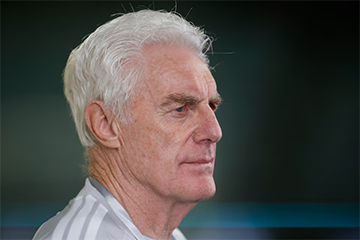
South Africa plan to arrive in Mexico almost a fortnight before the opening game of the World Cup in order to acclimatise to the altitude, coach Hugo Broos said.
Co-hosts Mexico open the tournament on June 11 with a Group A match against South Africa at the Azteca Stadium in Mexico City, which is 2,200m (7,216 feet) above sea level.
While most of the South African players are based at clubs in Johannesburg, which has an altitude of 1,753m, Broos says his squad need time to adjust to the conditions in Mexico before the opening game.
The squad will travel on May 30 to their base in Pachuca, which is around 200 metres higher than Mexico City. The city is less than 100 km from Mexico City.
“The first days it will be difficult to train at 100% because of the altitude, so that is what we will do in the second week,” Broos said in a radio interview.
South Africa plan to take on Nicaragua at home in a friendly on May 29, although this is not confirmed, and are negotiating to have Puerto Rico as a warm-up opponent for a second international scrimmage in Pachuca.
In their other World Cup group matches, South Africa will meet the Czech Republic in Atlanta on June 18 and South Korea in Monterrey on June 24, seeking to advance past the first round for the first time in their fourth World Cup appearance.
“It’s not an easy group for us. First of all, we will face the hosts in the opening game, at the Azteca Stadium, and it will be very difficult for us there,” Broos said earlier in the year.
But the veteran coach, who played for semi-finalists Belgium at the 1986 World Cup in Mexico, has also previously predicted his side could cause some upsets at the tournament, which is also being played in Canada and the U.S.
South Africa and Mexico drew 1-1 at Soccer City in Johannesburg in the opening game of the 2010 World Cup, which South Africa hosted.
Join the Sports Village Square channel on WhatsApp: https://whatsapp.com/channel/0029Vaz7mEIGk1FxU8YIXb0H

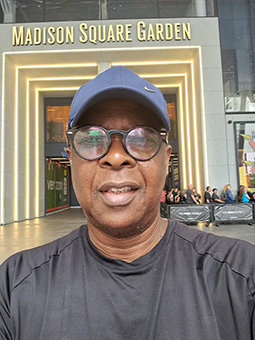

By Kunle Solaja, who was in New York
The World Cup is over. The accreditation card has been put away in the archive while my previous nine World Cup accreditations and scores of others are kept. My suitcase has been unpacked, and I am back home in Nigeria.
But the mind has not quite returned. It still wanders occasionally across the Atlantic, to the crowded streets of New York, the trains and buses, the hurried walks to assignments, the stadiums packed with supporters from across the world and those moments between matches when a journalist is briefly liberated from deadlines.
For 39 days, the FIFA World Cup 2026 dictated almost everything: where to go, what train or flight to catch, what match to attend, what story to pursue and, inevitably, what deadline had to be beaten.
It was my 10th consecutive FIFA World Cup, a journey stretching back 36 years to Italia ’90.
But as the FIFA World Cup 2026 reached its climax last Sunday and the final showdown between Argentina and Spain drew near, there was a brief window between assignments to visit one of the world’s most celebrated sporting cathedrals, the Madison Square Garden.
For any sports journalist, especially one with a passion for history, a trip to New York City is incomplete without stepping into the arena affectionately known simply as “The Garden.”
Located in the heart of Manhattan, above Pennsylvania Station and a short walk from the famed Fifth Avenue, Madison Square Garden has hosted some of the greatest moments in sports, entertainment and politics. While football dominates my itinerary, the visit was to Madison square, a sacred ground, became inevitable.
The experience began even before one entered the main bowl of the arena. On the first floor is a special concourse often referred to as Madison Square Garden’s “Walk of Fame.” This is a tribute-lined passageway celebrating the athletes, performers and personalities who have helped shape the venue’s rich legacy.
As I strolled along the walkway, I found myself pausing repeatedly to study the plaques and displays honouring sporting and entertainment giants.
It felt like a journey through decades of history. Every few steps brought another reminder of a memorable night, a championship triumph, a legendary performance or a historic contest that had unfolded under the Garden’s roof.


For a reporter who has spent years documenting sporting milestones across continents, the walkway offered a fascinating encounter with history. It was not merely a corridor leading into an arena; it was a museum of memories, connecting generations of fans and athletes.
Among the names and moments celebrated there, none resonated more strongly than those of Muhammad Ali.
The Garden became one of Ali’s favourite theatres. It was here, on March 8, 1971, that boxing witnessed what many still regard as the “Fight of the Century” when Ali faced unbeaten heavyweight champion Joe Frazier. The bout captivated the world and remains one of the most celebrated contests in sporting history.
Although Ali lost that night by unanimous decision, the fight elevated boxing to unprecedented global prominence and cemented Madison Square Garden’s reputation as the epicentre of world sport.
Ali would return repeatedly to the arena, creating more unforgettable memories. In 1974, he defeated Joe Frazier in their rematch at the Garden, a victory that paved the way for his famous “Rumble in the Jungle” triumph over George Foreman later that year.
Standing inside the building after passing through the Walk of Fame, one can almost imagine the roar of the crowd that greeted Ali’s dazzling footwork, lightning-fast combinations and charismatic showmanship. The echoes of those historic nights seem permanently embedded in the walls of the arena.
Yet Madison Square Garden’s story extends far beyond boxing. The arena has hosted NBA legends such as Michael Jordan, Magic Johnson and LeBron James. It is home to the New York Knicks and the New York Rangers. Tennis, wrestling, political conventions and major concerts have all found a place on its storied stage.
For a World Cup correspondent covering football’s biggest spectacle, the visit offered a welcome detour into sporting history.
The modern World Cup is creating new heroes and fresh memories across North America, but places like Madison Square Garden remind us that every generation builds upon the achievements of those who came before.
As the countdown to the World Cup final continues, the images of Lionel Messi inspiring Argentina and Spain chasing another global crown dominate the headlines.
But a few hours in Manhattan provided a different perspective, one that connected today’s football drama with the timeless legacy of Muhammad Ali and countless other sporting icons.
In a city that never sleeps, Madison Square Garden remains awake in history. And nowhere is that more evident than along the Walk of Fame, where every plaque tells a story and every step brings visitors closer to the legends who transformed an arena into a shrine of sporting greatness.
Join the Sports Village Square channel on WhatsApp: https://whatsapp.com/channel/0029Vaz7mEIGk1FxU8YIXb0H
- Summary
- Klopp named new Germany coach on a four-year deal
- Klopp says he’ll quit Germany job if family is targeted by media
- Former Liverpool boss succeeds Nagelsmann after early World Cup exit
- Krawietz, Lijnders and Bender join staff
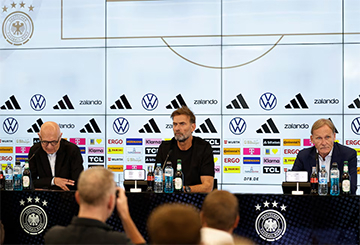
Juergen Klopp began his tenure as Germany coach with a warning to the media on Friday, saying he would quit the job if his family was not left in peace, as he was unveiled on a four-year contract.
The 59-year-old German, known for his high-intensity football and direct communication style, has been tasked with leading the four-times world champions into a new era after another disappointing World Cup campaign.
The former Liverpool and Borussia Dortmund manager replaces Julian Nagelsmann , who stepped down from the role after Germany’s penalty shootout defeat by Paraguay in the round of 32, extending the country’s run of poor World Cup performances following group-stage exits in 2018 and 2022.
“If you behave badly and don’t leave my family in peace then I’ll be gone, I’ll just turn away,” Klopp told reporters.
“I’m not doing this job for myself, I’m doing it for you. I’m taking this job even though I’ve seen how you’ve treated Julian Nagelsmann and Thomas Tuchel.
“I love this job but I am always ready to call it quits if need be.”
Klopp, who had been working as Red Bull’s global head of soccer after leaving Liverpool in 2024, will be assisted in the role by Peter Krawietz, Pep Lijnders and former Germany international Sven Bender.
In a typically expressive introductory press conference, he said the national team could connect “us Germans like hardly anything else” and that he was “looking forward to this special task in German football.”
‘RIGHT MAN AT THE RIGHT TIME’
German football association (DFB) president Bernd Neuendorf said Klopp had been the federation’s preferred candidate from the outset.
“Our talks with Juergen only strengthened our belief that he’s the right man at the right time,” Neuendorf added.
Red Bull executive Oliver Mintzlaff said the company had agreed to release Klopp to allow him to take the Germany job.
“This wasn’t an easy decision but together with my fellow managing directors, Franz Watzlawick and Alexander Kirchmayr, we decided to support his ambition,” Mintzlaff said.
Neuendorf said the federation would donate €1 million ($1.14 million) to Red Bull’s Wings for Life foundation instead of paying compensation. He confirmed Leipzig would host three Germany internationals in the coming years.
REBUILDING GERMANY
Germany’s latest early exit marked a third successive disappointing World Cup for a team that last lifted the trophy in 2014.
Klopp takes the job less than two years after joining Red Bull. He worked as a television pundit for German broadcasters during the World Cup and was widely viewed as the preferred choice among Germany fans.
However, he drew criticism during the tournament and later apologised after suggesting Nagelsmann’s time as national coach could be nearing an end.
One of Germany’s most successful club coaches, Klopp won two Bundesliga titles and the German Cup with Borussia Dortmund before taking charge of Liverpool in 2015. During nine years at Anfield, he led the club to almost every major honour, including the Champions League and Premier League titles.
“This (Germany) role is the highlight of my career and I’ll give all I’ve got to be successful,” Klopp said.
“I’m far from perfect. We’ve got a few weeks until the first international break. I think that’s enough time to get prepared.
“I want to look towards the most successful Germany coaches who also developed in the most successful way.”
The DFB said earlier this month that Nagelsmann had asked to be released from his contract following Germany’s World Cup exit.
Nagelsmann, who took charge in 2023 and became the youngest coach to lead a team in a World Cup knockout match in four decades at 38 years old, had said after the defeat that he was “not someone to say ‘I’m stepping down’ just because we were eliminated.”
-Reuters
Join the Sports Village Square channel on WhatsApp: https://whatsapp.com/channel/0029Vaz7mEIGk1FxU8YIXb0H
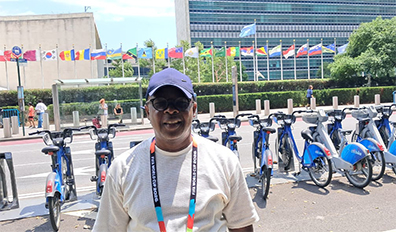
BY Kunle Solaja, who was at the UN
The FIFA World Cup brought me to New York, but on a rare free afternoon between deadlines, press conferences and match reports, I found myself drawn to another global institution that, in its own way, rivals FIFA in international significance—the United Nations Headquarters.
The visit was made even more compelling by geography. The imposing glass structure of the United Nations sits on Manhattan’s East Side, just a shouting distance from Nigeria House, the Permanent Mission of Nigeria to the United Nations, which I also took time to visit.
At the mission, I had the pleasant surprise of meeting a familiar face from Nigerian football history—former international Humphrey Edobor, who now serves as the mission’s first point of contact on the ground floor. We barely had enough time for a proper conversation, as his busy schedule and the steady stream of visitors demanded his attention.

Kunle Solaja (right) poses with former Nigeria international Humphrey Edobor during a visit to Nigeria House, the Permanent Mission of Nigeria to the United Nations in New York. Edobor, once one of Nigeria’s most exciting wingers, now serves at the mission.
For younger football followers, Edobor’s name may not immediately ring a bell, but in his playing days he was one of Nigeria’s most exciting wingers. He represented the country at the 1984 and 1988 Africa Cup of Nations, was a member of the Flying Eagles squad that competed at the 1983 FIFA World Youth Championship in Mexico, and enjoyed successful club careers with Bendel Insurance, New Nigeria Bank, Leventis United and El-Kanemi Warriors before taking his career abroad.
For a Nigerian journalist covering the world’s biggest sporting event, the closeness of Nigeria House to the United Nations felt symbolic. One building represents the world’s largest gathering of nations in diplomacy, while the other projects Nigeria’s identity, interests and voice on the international stage.
The walk along First Avenue was refreshing. Unlike the frenetic energy of Times Square, where giant electronic billboards compete for attention, and tourists move in endless streams, this corner of Manhattan exudes a quieter authority.
The flags of the world’s nations fluttered in disciplined formation outside the United Nations complex, creating perhaps the most colourful display of international unity anywhere on earth.
As I approached the headquarters, the iconic Secretariat Building rose majestically against the New York skyline. The structure, instantly recognisable from countless television broadcasts and newspaper photographs, looked both familiar and awe-inspiring at the same time. Here, presidents, prime ministers, monarchs and diplomats gather to debate issues affecting billions of people.
For a brief moment, my role as a football correspondent seemed to give way to something entirely different. Walking through the same gates that have welcomed generations of world leaders, heads of state, presidents and diplomats, carrying my visitor’s identification badge, I found myself imagining—if only fleetingly—what it must feel like to be part of the global diplomatic community. It was a rare feeling of stepping, however briefly, into the arena where history is discussed, differences are negotiated, and decisions that shape the world are made.

A memorable moment as I stepped into the United Nations Headquarters in New York, the global centre of diplomacy, during a break from my FIFA World Cup reporting assignment.
Only days earlier, I had watched Argentina and England battle fiercely for a place in the FIFA World Cup final. Before that, I had witnessed the emotional highs and lows of Morocco’s remarkable campaign.
Standing before the United Nations, however, I was reminded that football, despite its fierce rivalries, often serves a purpose remarkably similar to diplomacy. It brings people together across borders, languages, religions and cultures, creating common experiences that transcend politics and geography.
Like any institution of global importance, the United Nations operates with carefully observed protocols. Visitors first undergo security screening before entering the complex. Entry also requires advance online booking, after which each visitor is issued a personalised photo identification pass bearing the date of the visit.

My customised United Nations visitor’s identity card—a treasured addition to a growing collection of memorabilia gathered from covering ten consecutive FIFA World Cups and visiting iconic global institutions.
For those few hours, wearing that official visitor’s pass and moving through the corridors of the world’s foremost diplomatic institution, I could not help but feel a quiet sense of privilege. It was, perhaps, the closest a sports journalist could come to experiencing life as a diplomat—representing no government, yet sharing the same space where nations engage one another through dialogue rather than conflict.
Inside the visitors’ area, the atmosphere was calm and purposeful. Tourists from every continent mingled with diplomats, UN staff members and school groups. Different languages filled the air, yet there was a shared sense of curiosity, respect and international fellowship.
The famous General Assembly Hall was particularly striking. Seeing the chamber where representatives of the UN’s 193 member states gather underscored the immense scale of the institution. One could almost imagine the echoes of the historic speeches delivered there over the decades—moments that have shaped global history.

A view of the United Nations chambers through my lens, offering a glimpse into the venue where representatives of the world’s nations gather to deliberate on issues of global importance.
One of the first sights greeting visitors inside the main building is the imposing statue of the legendary Nelson Mandela. It was impossible to walk past without pausing. Naturally, it presented an irresistible photo opportunity, standing beside the likeness of one of the world’s greatest symbols of peace, reconciliation and human dignity.

Posing beside the statue of Nelson Mandela at the United Nations Headquarters—a fitting tribute to one of the world’s enduring symbols of peace, reconciliation and human dignity.
Outside, I paused once more at the line of national flags. My eyes instinctively searched for the green-white-green banner of Nigeria. There it was, standing proudly among the colours of the world—a reassuring reminder that despite being thousands of kilometres from home, Nigeria remained firmly represented in this global city.
That simple sight unexpectedly brought me back to the World Cup.
Throughout the tournament, I had watched supporters proudly wave their national colours in stadiums stretching from Vancouver to Atlanta and from Boston to New York. The flags outside the United Nations represented a different kind of contest—not one measured by goals, trophies or league tables, but by dialogue, cooperation and the collective pursuit of peace.
As the evening sun reflected off the glass façade of the Secretariat Building, transforming it into a shimmering tower of light, I reluctantly began my walk back.
Then came a surprise.
Just as I was leaving the main building, a voice called my attention. A Nigerian working at the United Nations, Kolawole Olugboye, tapped me on the shoulder. Meeting a fellow compatriot in such an international environment added another memorable moment to an already enriching visit. We exchanged warm greetings, sharing that familiar bond Nigerians often discover with one another far from home.

A memorable encounter with Kolawole Olugboye, a Nigerian working at the United Nations, whose warm welcome added a special touch to my visit to the world body’s headquarters in New York.
Soon, however, the demands of World Cup reporting beckoned once again. Another deadline. Another match. Another story. Another chapter in what had become my historic tenth consecutive FIFA World Cup coverage.
Yet the visit left me with a lasting reflection.
Football may be the world’s game, but the United Nations remains the place where the world itself comes together.
In New York, those two worlds exist almost side by side—one celebrating competition, passion and sporting excellence; the other devoted to dialogue, cooperation and peace. Between them stands Nigeria House, proudly representing the country in the global conversation.
For one unforgettable afternoon during the FIFA World Cup, I had the privilege of walking through all three.
Join the Sports Village Square channel on WhatsApp: https://whatsapp.com/channel/0029Vaz7mEIGk1FxU8YIXb0H


A World Cup Reporter’s Pilgrimage to Madison Square Garden

Morocco Target Third Straight WAFCON Final as Atlas Lionesses Chase Elusive Continental Crown

‘AJ IS BACK!’ – Usyk Tips Joshua To Knock Out Fury After Prenga Scare
Breaking! Uzoho suspended from Super Eagles’ next match with Sierra Leone
NIGERIAN FOOTBALL CHIEF EXECUTIVE, SANUSI CHARGES NIGERIAN COACHES TO BE UPRIGHT, DILIGENT
No longer Super League as CAF changes name of its new clubs competition
-

 World Cup6 days ago
How a 64-team World Cup could transform soccer’s economics
-

 World Cup7 days ago
Reuters: 10 Key Takeaways from the 2026 FIFA World Cup
-

 World Cup1 week ago
The economic goal that never came: World Cup falls short of boosting Mexico
-

 World Cup7 days ago
FIFA Salutes Kunle Solaja as Historic World Cup 2026 Draws to a Close
-

 World Cup1 week ago
Spain’s Sanchez to attend World Cup final alongside Trump amid tensions
-

 Boxing1 day ago
BREAKING: FROM THE CANVAS TO CHAOS! Joshua destroys Prenga after two knockdowns
-

 AFCON2 days ago
CAS to hear Senegal’s appeal against African Cup of Nations title removal on October 8
-

 World Cup1 week ago
Mbappe Becomes World Cup’s All-Time Leading Scorer with 22 Goals