
World Cup
Osimhen may be fit for Nigeria’s World Cup Matchday 2 duel with Zimbabwe

In Napoli, fans and officials are anxiously awaiting Victor Osimhen’s speedy recovery.
According to a news outlet in Naples, Italy, Tuttonapoli, the rumour mill has it that there is no delay in the player’s recovery.
They are looking forward to 25 November for him to feature in a very important away match at Atalanta.
If Osimhen is fit enough for the 25 November Serie A match, he may as well be available for Nigeria’s potentially challenging World Cup qualifying duel away to Zimbabwe six days to the Atalanta versus Napoli Match.
He is certain to miss the Super Eagles’ opening World Cup qualifying match against Lesotho in Uyo.
Gazzetta dello Sport quoted his club’s coach, Rudi Garcia saying he hoped Osimhen would be available sooner than expected.
“I didn’t deal with this thing, the doctors and the managers did. I’ve exchanged messages with Victor, because for now I’ve been taking care of those who can play. After these two games there is a break and I think he will be ready for Atalanta when the league resumes”, said Garcia.
It however reports that “obviously it will be the training sessions that will make it clearer.”
Osimhen has been in Nigeria for a while and is being expected back in Napoli on Wednesday and could watch his club’s Champions League match with Union Berlin.



Madonna and Shakira will line up with K-pop supergroup BTS to headline the first-ever World Cup final halftime show at MetLife Stadium in New Jersey, FIFA said on Thursday.
Coldplay singer Chris Martin will curate the extravaganza scheduled for July 19, the tournament’s organiser added.
“The FIFA World Cup 2026 Final halftime show will be a truly special moment, bringing together music, football and a shared commitment to improving the lives of children around the world,” FIFA president Gianni Infantino said on social media.
“Together, we will support the FIFA Global Citizen Education Fund and help create greater access to quality education and football for children worldwide.”
The 48-team World Cup, co-hosted by the United States, Canada, and Mexico, will run from June 11 to July 19. The tournament will feature 104 matches, up from the previous 64, including an additional knockout round.
Last year’s Club World Cup in North America, which served as a test run for the World Cup, also featured a halftime show including performances from American rapper Doja Cat, Colombian singer J Balvin and Nigerian singer Tems.
-Reuters
Visit the Sports Village Square Channel:
https://www.whatsapp.com/channel/0029Vaz7mEIGk1FxU8YIXb0H
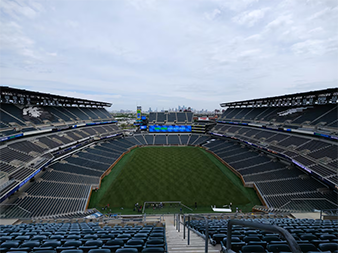
Football’s global players’ union renewed concerns on Thursday about heat at the 2026 World Cup after scientists warned that the likelihood of dangerous temperatures for players and fans has sharply increased.
An analysis by climate research group World Weather Attribution found that roughly a quarter of the 104 matches at the expanded tournament across the United States, Mexico and Canada are likely to be played in conditions exceeding safety limits recommended by FIFPRO, almost twice the risk seen at the 1994 World Cup in the U.S.
Around five matches could take place in conditions considered unsafe, where postponement would be advised, the researchers said.
Scientists assessed the risk using kickoff times and the Wet Bulb Globe Temperature (WBGT) index, which measures how effectively the body can cool itself.
“The calculations to estimate the likelihood of 2026 FIFA World Cup games being played in high WBGT conditions are in line with FIFPRO’s calculations published in 2023,” said FIFPRO’s medical director, Vincent Gouttebarge.
“These estimations justify the need for – and implementation of – a series of mitigation strategies with a view to better protecting players’ health and performance when they are exposed to hot conditions.”
FIFPRO recommends cooling measures when WBGT rises above 26 degrees Celsius and says matches should be postponed if it exceeds 28C, which is equivalent to roughly 38C in dry heat or 30C in high humidity.
FIFA told Reuters that it has carried out heat-risk planning, with measures including three-minute hydration breaks in each half of games, cooling infrastructure for fans and players, adapted work-rest cycles, and enhanced medical readiness that scale according to real-time conditions.
“FIFA is committed to protecting the health and safety of players, referees, fans, volunteers and staff,” the global governing body said in a statement.
‘MORE CONSERVATIVE FOOTBALL’
Chris Mullington, consultant anaesthetist at Imperial College London NHS Trust and clinical senior lecturer at Imperial College London, said extreme heat is more likely to influence how games are played than trigger widespread medical emergencies among players.
“It will be more of a performance issue than a health issue,” he said. “These players are elite athletes and acclimatised. You’ll see players self-pacing. That behavioural thermoregulation is very difficult to override.
“So you may end up with more conservative football.”
Cooling systems are expected to reduce some of the risk at three of the 16 host venues, according to the analysis.
However, more than a third of games with at least a 10% chance of exceeding 26 C WBGT are scheduled at stadiums without air conditioning, including Miami, Kansas City, New York and Philadelphia.
That includes the final at MetLife Stadium in East Rutherford, New Jersey, which now faces a one-in-eight chance of exceeding the 26 C threshold and a roughly 3% risk of reaching the more dangerous level — about double the risk it would have carried in 1994, the analysis said.
Friederike Otto, professor of climate science at Imperial College London, said the findings highlighted the need for FIFA to reconsider when future World Cups are scheduled, particularly in regions vulnerable to extreme summer heat.
“From a health point of view, it would be advisable to have these (World Cups) either earlier or later in the year, so you can have a football party rather than something that is a massive health risk for the whole city,” said Otto.
FIFPRO also warned that while air-conditioned stadiums in cities such as Dallas and Houston may help protect players, fans attending matches and outdoor fan festivals could remain exposed to prolonged periods of dangerous heat.
-Reuters
Visit the Sports Village Square Channel:
https://www.whatsapp.com/channel/0029Vaz7mEIGk1FxU8YIXb0H
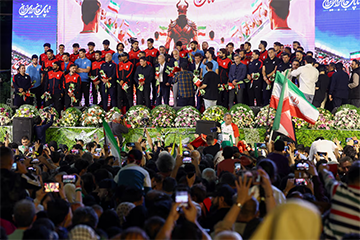
Iran hosted a World Cup departure rally attended by thousands of fans in Tehran’s Enqelab Square on Wednesday night, even though concerns remain about the team getting into the United States and competing at the tournament.
The players, who will continue their preparations at a training camp in Turkey next week, were cheered by the crowd as they made patriotic statements from a stage, and the kit they will wear at the June 11 to July 19 tournament was unveiled.
“This is the best send-off in the last four World Cup campaigns,” Iranian FA (FFIRI) President Mehdi Taj told state TV.
“The players are with the people, and the crowd stands with the country’s dignity, honour, and strength. Whatever the result, may Iran’s flag be raised there and defended.”

Iran’s national soccer team head coach Amir Ghalenoei and Iran Football Federation President Mehdi Taj attend the team’s farewell ceremony ahead of their departure to the 2026 World Cup in Tehran, Iran, May 13, 2026. Majid Asgaripour/WANA (West Asia News Agency) via REUTERS
Iran’s participation in the World Cup has been in question since the U.S. and Israel started the regional war by launching air strikes on the Islamic Republic in late February.
Taj was refused entry to co-host nation Canada for the FIFA Congress two weeks ago because of his connection to the Islamic Revolutionary Guard Corps (IRGC), triggering fears there may be issues for some of the Iranian delegation getting into the U.S.
As in Canada, the IRGC is classified as a “terrorist entity” in the U.S., and Secretary of State Marco Rubio has said no one with ties to the organisation would be admitted to the country.
Iran has placed responsibility for getting the players and team officials into the U.S., where Team Melli are scheduled to play all three World Cup group matches, firmly in the hands of tournament organisers FIFA.
“Nothing has arrived yet regarding the visas. We hope it will definitely be handled within this timeframe,” Hedayat Mombeini, the FFIRI secretary-general, told state TV at the rally on Wednesday.
“FIFA has made promises, and hopefully those promises will lead to results, and the players will receive their visas on time.”
Reports that some Iraqi players had been refused U.S. visas, which were quickly refuted by the White House and Iraq Football Association on Wednesday, further fuelled Iranian concerns.
“I just heard that news as well,” Mombeini added.
“I hope FIFA steps in … we have always believed sport should be separate from politics. So in my view, FIFA has a duty to step in and make sure entry for all members of all World Cup teams is facilitated.”
Iran will play Gambia in a World Cup warm-up in Antalya on May 29, and Mombeini said the FFIRI was in the process of arranging another friendly for the training camp in Turkey.
-Reuters
Visit the Sports Village Square Channel:


Madonna, BTS and Shakira to headline first World Cup final halftime show

Study warns of dangerous heat at 2026 World Cup as climate risks grow

Iran hold World Cup departure rally despite continuing concerns
Breaking! Uzoho suspended from Super Eagles’ next match with Sierra Leone
No longer Super League as CAF changes name of its new clubs competition
NIGERIAN FOOTBALL CHIEF EXECUTIVE, SANUSI CHARGES NIGERIAN COACHES TO BE UPRIGHT, DILIGENT
-

 World Cup6 days ago
FIFA Plans Three Opening Ceremonies in All Host Nations for 2026 World Cup
-

 World Cup6 days ago
United States Unveils Hollywood-Style FIFA World Cup 2026 Opening Ceremony
-

 World Cup6 days ago
Mexico president wavers on plan to cut school year by 40 days for the World Cup
-

 World Cup7 days ago
Burna Boy Joins Shakira for Official 2026 World Cup Song ‘Dai Dai’
-

 World Cup1 day ago
US drops bond requirement for World Cup ticket holders
-

 Nigerian Football3 days ago
NPFL at 36: Why Nigeria’s League Top Scorers Rarely Become Super Eagles Legends
-

 World Cup1 day ago
White House: No visa issues for Iraq’s World Cup team
-

 World Cup2 days ago
Magic Johnson Leads Campaign to Showcase Los Angeles Ahead of World Cup