
AFCON
ROADS TO AFCON 2021 AND WORLD CUP 2022 EMERGE TODAY

The path that teams will take to get to the 33rd Africa Cup of Nations in Cameroon and the World Cup in Qatar 2022 will be drawn on Thursday.
Both preliminary competitions may be combined like the editions for 2006 and 2010.
The preliminary competition in Africa will begin in September with the lesser-rated teams contesting.
Almost every CAF member country entered for the competitions except Eritrea and Somalia. The seeding for the draw had been made earlier in the month.
At the end of the preliminary competitions, 24 teams will be at the Africa Cup of Nations while five will go the World Cup.
The draw for the preliminary competitions will begin with the eight teams in Pot 5 will be drawn into four pairings and the winners of the two-leg ties advance to the second stage to join Pot 4 in other to see each pot having 12 teams.
In the second stage of the draw, there will be 12 groups comprised of one team from pots 1-4 and the section winners and runners-up qualify for the finals.
Hosts Cameroon are guaranteed a place so only one other team qualify from their group
The seeding runs thus:
Pot 1: Senegal, Tunisia, Nigeria, Morocco, Democratic Republic of Congo, Ghana, Cameroon (hosts), Egypt, Burkina Faso, Mali, Cote d’Ivoire, Algeria
Pot 2: Guinea, South Africa, Cape Verde, Uganda, Zambia, Benin, Gabon, Congo Brazzaville, Mauritania, Niger, Kenya, Libya
Pot 3: Madagascar, Zimbabwe, Central African Republic, Namibia, Sierra Leone, Mozambique, Guinea-Bissau, Angola, Malawi, Togo, Sudan, Tanzania
Pot 4: Burundi, Rwanda, Equatorial Guinea, eSwatini (formerly Swaziland), Lesotho, Botswana, Comoros, Ethiopia and four preliminary-round winners
Pot 5: Liberia, Mauritius, Gambia, South Sudan, Chad, Sao Tome e Principe, Seychelles, Djibouti
Did not enter: Eritrea, Somalia

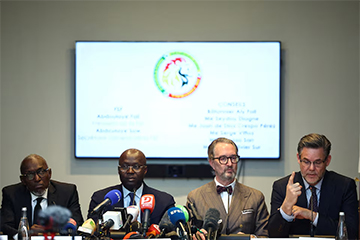

Senegal’s appeal against being stripped of their African Cup of Nations title will be heard on October 8, the Court of Arbitration for Sport (CAS) said on Friday.
Senegal were ruled to have forfeited the game in Rabat on January 18 because they walked off the pitch in protest at a potentially decisive penalty awarded to opponents Morocco.
They returned after 14 minutes to win the match 1-0, but the appeal board of African soccer’s governing body (CAF) replaced that result with a 3-0 victory for Morocco in March.
The Senegalese government called for an inquiry into the removal of the title, and the country’s soccer federation (FSF) appealed to CAS.
A CAS panel will hold the hearing behind closed doors at its headquarters in Lausanne, Switzerland, CAS said in a statement.
“After the hearing, the panel will start its deliberations. At this stage, CAS cannot state when a final decision will be rendered but it will not be on the day of the hearing,” CAS added.
-Reuters
r
Join the Sports Village Square channel on WhatsApp: https://whatsapp.com/channel/0029Vaz7mEIGk1FxU8YIXb0H


The Confederation of African Football (CAF) has officially opened the bidding process for countries interested in hosting the Africa Cup of Nations (AFCON) in 2028, 2032 and 2036, with several member associations already submitting proposals.
CAF President Dr Patrice Motsepe disclosed that the bidding exercise is progressing smoothly and described the level of interest from prospective hosts as encouraging.
“The bidding process is progressing very well, and numerous exciting bids have been submitted by potential host countries,” CAF said, adding that announcements on successful hosts will be made in due course.
Meanwhile, CAF confirmed that its 48th Ordinary General Assembly will be held in Abuja, Nigeria, on November 21, 2026.
The continental governing body expressed appreciation to the Federal Government of Nigeria and the Nigeria Football Federation (NFF) for their cooperation in preparations for the event.
CAF said the General Assembly is expected to attract football leaders from across the continent and will play a significant role in shaping policies aimed at accelerating the development and growth of African football.
The organisation added that the Abuja gathering is expected to be one of its most significant assemblies in recent years as CAF continues implementing reforms across competitions, infrastructure development, youth football and governance.
Join the Sports Village Square channel on WhatsApp: https://whatsapp.com/channel/0029Vaz7mEIGk1FxU8YIXb0H
By Kunle Solaja
Niger, Mali and Burkina Faso have taken the first step towards jointly hosting the 2032 Africa Cup of Nations after submitting an expression of interest to the Confederation of African Football (CAF).
The Nigerien Football Federation announced that CAF had accepted the joint declaration submitted by the three West African nations, marking the opening phase of the bidding process.
However, the acceptance of the expression of interest does not amount to an award of the hosting rights, as the countries must still undergo CAF’s comprehensive evaluation process before a final decision is made.
The three football federations unveiled their joint project following a meeting with CAF President Patrice Motsepe in the United States during the closing stages of the 2026 FIFA World Cup.
The proposed bid brings together the three members of the Alliance of Sahel States, reflecting their ambition to co-host one of Africa’s biggest sporting events and strengthen regional cooperation through football.
Earlier this month, CAF officially opened the bidding process for the 2028, 2032 and 2036 editions of the Africa Cup of Nations, inviting all 54 member associations to submit expressions of interest. The continental governing body said all bids would be assessed based on strict technical, financial and legal criteria.
As the next stage of the process, Niger, Mali and Burkina Faso must prepare a comprehensive bid dossier outlining the proposed host cities, stadiums, training facilities, transport infrastructure, accommodation capacity and security arrangements.
CAF has yet to announce the timetable for selecting the 2032 host nation(s) or reveal the full list of countries expected to compete for the hosting rights.
Should the joint bid eventually succeed, the tournament would return to Mali for the first time since it staged the 2002 Africa Cup of Nations. It would also mark a historic first for both Niger and Burkina Faso, neither of which has previously hosted the continent’s flagship football championship.
The bid underscores the growing trend of joint hosting arrangements for major football tournaments, allowing neighbouring countries to pool infrastructure and resources while expanding the reach of the competition across multiple nations.
Join the Sports Village Square channel on WhatsApp: https://whatsapp.com/channel/0029Vaz7mEIGk1FxU8YIXb0H


Amstel Malta Rallies Nigerians Behind Super Falcons’ Quest for 11th WAFCON Crown

Mission XI As Super Falcons Begin WAFCON Title Defence Against Debutants Malawi

Flying Eagles Outgun Ghana 4-2 in Six-Goal WAFU B Thriller
Breaking! Uzoho suspended from Super Eagles’ next match with Sierra Leone
NIGERIAN FOOTBALL CHIEF EXECUTIVE, SANUSI CHARGES NIGERIAN COACHES TO BE UPRIGHT, DILIGENT
No longer Super League as CAF changes name of its new clubs competition
-

 World Cup6 days ago
How a 64-team World Cup could transform soccer’s economics
-

 World Cup1 week ago
Reuters: 10 Key Takeaways from the 2026 FIFA World Cup
-

 World Cup1 week ago
The economic goal that never came: World Cup falls short of boosting Mexico
-

 World Cup1 week ago
FIFA Salutes Kunle Solaja as Historic World Cup 2026 Draws to a Close
-

 Boxing2 days ago
BREAKING: FROM THE CANVAS TO CHAOS! Joshua destroys Prenga after two knockdowns
-

 AFCON3 days ago
CAS to hear Senegal’s appeal against African Cup of Nations title removal on October 8
-

 World Cup1 week ago
Mbappe Becomes World Cup’s All-Time Leading Scorer with 22 Goals
-

 WAFCON4 days ago
Stars on their shirts! Amstel Malta-backed Super Falcons flaunt 10-title glory ahead of WAFCON